A government with no one left to call
By October the Provisional Government under Alexander Kerensky had exhausted every source of support it started with in February. It kept Russia in a war the army no longer wanted to fight, deferred land reform peasants had already begun taking by force, and lost the loyalty of the Petrograd garrison after using troops to crush a right-wing coup attempt in August.
The Bolsheviks had spent the summer rebuilding after a failed uprising in July, when Lenin fled to Finland in disguise. By autumn the party held majorities in the Petrograd and Moscow soviets, and Leon Trotsky, now chairing the Petrograd Soviet, ran the Military Revolutionary Committee that planned the seizure of power.
Kerensky himself sensed the ground shifting under him. He appealed to Cossack units and officer cadets for protection in the war's fourth autumn, but many simply declined to muster, having already concluded that a government unwilling to end the war or feed the cities was not worth dying to save. Bread queues in Petrograd by October routinely stretched for hours, and flour shortages that had helped trigger the February Revolution had never actually been resolved by the government that replaced the Tsar. Desertion from the front had reached the hundreds of thousands, with soldiers simply walking home to claim land before their neighbours did.
1 shot
blank round fired by the cruiser Aurora as the signal
~6
defenders killed taking the lightly held Winter Palace
9 months
between the February and October revolutions of 1917
7–10m
estimated deaths in the civil war that followed, 1918–1922
A night with almost nothing to storm
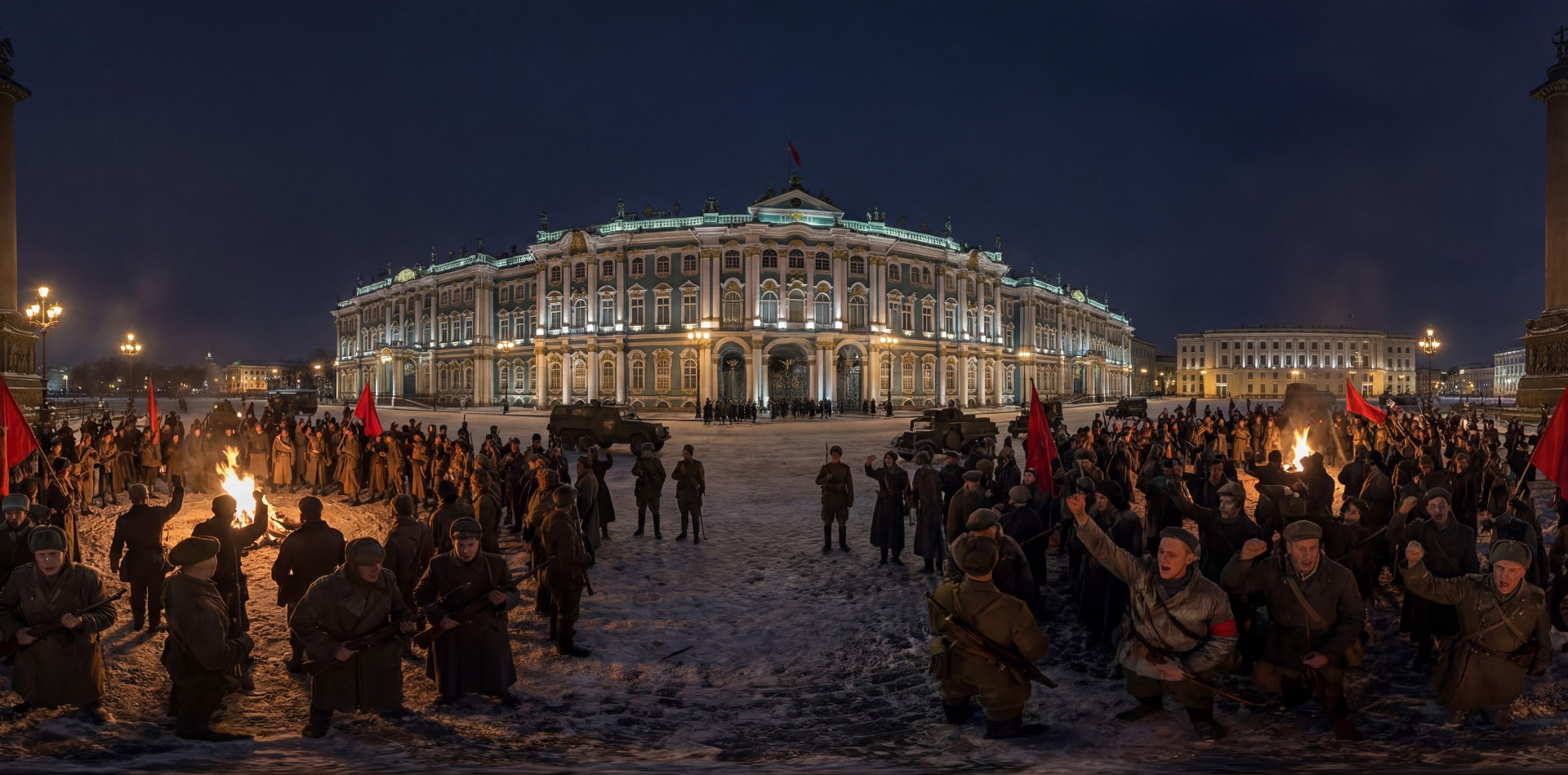
The Winter Palace was defended by a few hundred military cadets, some Cossacks who left before the fighting started, and the Women's Battalion of Death. Red Guards and sailors from Kronstadt took the telegraph office, bridges, railway stations and the State Bank hours before anyone moved on the palace itself, methodically rather than dramatically.
The cruiser Aurora, anchored on the Neva, fired one blank round after 9pm as the agreed signal. Government ministers were arrested in the small hours of 26 October, sitting in a palace room, having issued orders that no one outside was left to carry out.
Kerensky himself was already gone by then, having left Petrograd that morning in a requisitioned car to seek loyal troops outside the city, a search that failed within days and left him fleeing into permanent exile rather than commanding any counter-attack. American journalist John Reed watched much of the night unfold from the streets and the Congress hall itself, and turned his notes into Ten Days That Shook the World, published in 1919 and later prefaced approvingly by Lenin himself as an account foreigners should read to understand what had actually happened.
We shall now proceed to the construction of the Socialist order.
The vote that followed
Hours after the palace fell, the Second All-Russian Congress of Soviets convened and, after Mensheviks and moderate socialists walked out in protest, approved a Bolshevik government headed by Lenin. Trotsky reportedly told the departing delegates they were finished, consigned to "the dustbin of history" — a line historians still argue over word for word.
Within weeks the new government took Russia out of the war, began nationalising land and banks, and dissolved the elected Constituent Assembly it had allowed to convene in January 1918, when the results went against it. Civil war followed within months and would kill far more people than the revolution itself.
The apparatus assembled that night — the Council of People's Commissars, the Cheka founded in December to police dissent — outlasted the emergency that produced it, hardening from a wartime improvisation into the governing structure of the Soviet state for the next seven decades. In early 1918 the new government also abandoned the Julian calendar Russia had used for centuries, adopting the Gregorian calendar already standard in the West, which is why the October Revolution's anniversary is marked in November: the night described here fell on 25–26 October by the old reckoning and 7–8 November by the new one.
What everyone says
The Winter Palace was taken by a mass armed assault, as shown in Eisenstein's film.
What the evidence says
Sergei Eisenstein's 1928 film October restaged the event as a heroic storming with thousands of extras, and that footage became the visual memory of the revolution. Contemporary accounts describe a much smaller, largely undefended building entered by scattered groups with barely any fighting.
What the palace kept
The Winter Palace survived the night with remarkably little structural damage; looting was more of a problem afterward than the assault itself, and Bolshevik patrols shot at least a few of their own men caught raiding the wine cellars, and guards reportedly had to be posted specifically to stop looting of the tsar's wine stock, valued at the time in the millions of roubles. Within years the building became part of the State Hermitage Museum, its imperial rooms opened to the public it had once been sealed against.
Petrograd itself was renamed Leningrad in 1924, and the events of that night were re-narrated repeatedly by the state that grew from them, most famously in Sergei Eisenstein's 1928 film, which supplied a mass-storming image the real event never had.
Today the square outside is Palace Square, still used for parades and concerts, and the room where the ministers were arrested is marked for visitors. The gap between the modest, almost anticlimactic reality of October 1917 and its enormous historical weight remains one of the odder facts of the twentieth century. Visitors today can walk the same Malachite and Jordan Staircase halls the ministers crossed under arrest, now hung with paintings rather than soldiers.
How it unfolded
March 1917· the scene
The February Revolution forces the Tsar's abdication.
July 1917
A premature Bolshevik uprising fails; Lenin flees to Finland.
September 1917
Bolsheviks win majorities in the Petrograd and Moscow soviets.
Night of 25–26 October 1917
The scene here: Red Guards and sailors move on the Winter Palace.
26 October 1917
The Congress of Soviets approves Lenin's new government.
1918
Russia exits the First World War; civil war begins within months.