Two movements, one stage
The march's official name — the March on Washington for Jobs and Freedom — signalled a coalition rarely credited in the shorthand version of the day. A. Philip Randolph had been agitating for a march on the capital since 1941, when the mere threat of one forced Franklin Roosevelt to desegregate defence-industry hiring. Bayard Rustin, a gay former Communist whose past made him a political liability, did the actual organising from behind the scenes.
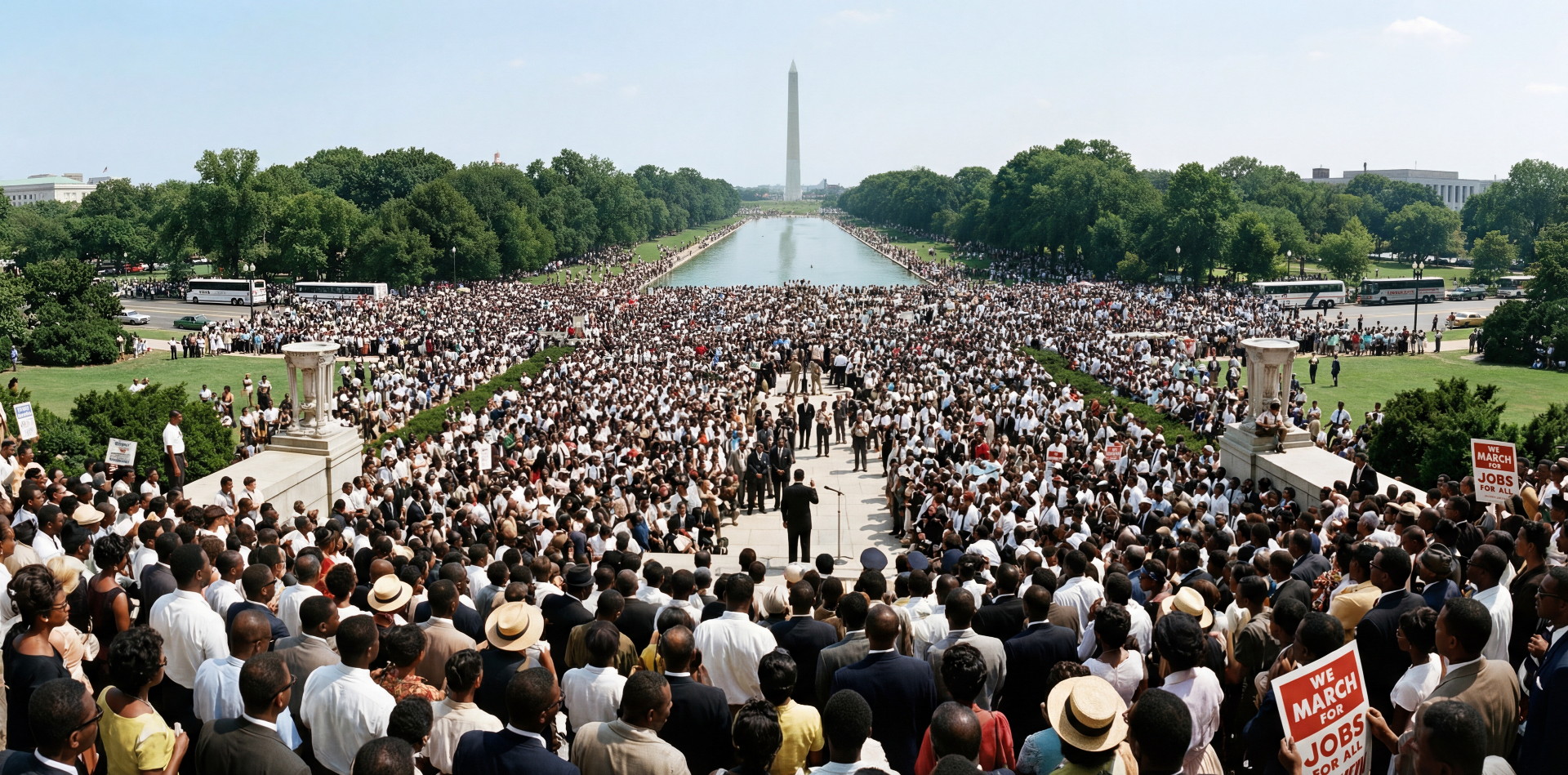
Labour unions bankrolled roughly 2,000 chartered buses that converged on the capital from as far as Chicago and Detroit, plus at least 21 special trains and a handful of chartered flights, and printed the identical placards seen in every photograph — a deliberate choice to keep the messaging disciplined after infighting nearly split the coalition over how sharply to criticise the Kennedy administration. Bayard Rustin ran the whole arrival schedule from a checklist on a clipboard, staggering bus convoys by the half-hour so the Mall would fill without gridlock.
Washington's police force, fearing violence, cancelled leave for its officers and the city closed liquor stores for the day; the National Guard was quietly placed on standby, and 19,000 troops were stationed at bases within reach of the capital. None of it was needed. Organisers later noted that not a single arrest connected to the march was recorded that day, a fact contemporary commentators found more remarkable than almost anything said from the podium.
~250,000
people gathered on the Mall and around the pool
17 min
length of King's speech, the last of ten scheduled
6
civil rights and labour groups forming the coalition — the Big Six
18 days
before the Birmingham church bombing killed four girls
The speech before the speech
John Lewis, then chairman of the Student Nonviolent Coordinating Committee, arrived with a draft so blunt about federal inaction that older organisers forced last-minute rewrites in a room behind the memorial, finishing minutes before he spoke. King's own address had been through several drafts too, and the closing riff about a dream was not in the text his aides had mimeographed for the press.
Mahalia Jackson, seated near the podium, is widely credited with calling out 'Tell them about the dream, Martin' as he began to wind down a speech that was, until that point, workmanlike by his own standards and built around the metaphor of a bad cheque returned marked 'insufficient funds.' He pushed the pages aside and preached instead, speaking largely from memory for the closing minutes.
King had used the dream imagery before, in Detroit two months earlier, but never to a crowd of this size or in this setting. Standing almost exactly where Marian Anderson had sung to an integrated audience in 1939, he spoke for seventeen minutes, the last of ten scheduled speakers that afternoon.
I have a dream that my four little children will one day live in a nation where they will not be judged by the color of their skin but by the content of their character.
What it actually moved
Kennedy had introduced civil rights legislation two months earlier and initially opposed the march for fear it would derail the bill in Congress; he met the ten march leaders in the Oval Office that evening for close to an hour, and came away, aides said, impressed rather than alarmed by the day's discipline. He was assassinated in Dallas on 22 November 1963, less than three months later, before either bill he had proposed became law.
Lyndon Johnson used the momentum, and Kennedy's death, to push the Civil Rights Act through the Senate over a 54-day filibuster in 1964 and the Voting Rights Act in 1965. Four girls — Addie Mae Collins, Cynthia Wesley, Carole Robertson and Denise McNair — were murdered in the 16th Street Baptist Church bombing in Birmingham eighteen days after the march, a brutal reminder of how far short 'freedom' still fell for many of the people who had just filled the Mall.
The march is remembered now almost entirely for King's closing minutes, but the day's demands were concrete and largely unmet at the time: a $2 minimum wage, an end to segregated schools, and federal protection for voter registration drives across the South.
What everyone says
The entire speech was written in advance.
What the evidence says
King had used dream imagery in earlier speeches, but the extended 'I have a dream' passage that closes the address was improvised on the steps, after Mahalia Jackson urged him to depart from his prepared remarks.
The speech that got rewritten overnight
John Lewis's original draft accused the Kennedy administration of doing too little too late and asked, pointedly, which side the federal government was actually on; it also threatened to 'march through the South the way Sherman did.' A. Philip Randolph and Archbishop Patrick O'Boyle, who was due to give the invocation, refused to appear on the same platform unless the language was softened, and Lewis rewrote key passages by hand hours before he spoke.
The Civil Rights Act became law in July 1964, banning discrimination in public accommodations and employment, and the Voting Rights Act followed in August 1965, outlawing the literacy tests and other devices Southern states had used to keep Black citizens off the electoral roll. Neither bill was assured on the day of the march; both drew directly on the pressure the crowd's size had generated in Washington.
A bronze marker now sits on the Lincoln Memorial steps at the spot where King stood, added in 2003 for the march's fortieth anniversary, worn smooth in places by visitors who stand on it deliberately to look out over the same reflecting pool and the same stretch of Mall that filled with a quarter of a million people that August afternoon.
How it unfolded
1941
Randolph's threatened march forces FDR to desegregate defence-industry jobs.
June 1963· the scene
Kennedy proposes civil rights legislation; organisers begin planning the march.
28 Aug 1963, morning
Crowds fill the Mall far beyond the expected numbers.
28 Aug 1963, afternoon
The scene here: King closes the programme from the memorial steps.
1964–65
The Civil Rights Act and Voting Rights Act pass into law.