A tax cut as a trap
The East India Company was drowning in unsold tea and debt, and the 1773 Tea Act let it ship directly to the colonies, undercutting smuggled Dutch tea and even lowering the price colonists paid, tax included. The catch was the surviving Townshend duty: buying it meant tacitly accepting Parliament's right to tax colonists who had no representation in it.
Colonial merchants also stood to lose their smuggling profits to Company-appointed consignees, which is why opposition came from wharves and counting houses as much as from ideology. In New York and Philadelphia, ships were simply turned back before they could unload, and their captains sailed home without ever landing a chest of the Company's tea.
Boston's own consignees included two of Governor Thomas Hutchinson's sons, which made the dispute feel personal as well as political; unlike in the other port cities, Hutchinson refused to let the ships leave without paying duty, leaving the tea to sit, taxed and unsold, in the harbour. Customs law also gave the ships only twenty days after arrival to pay duty or have their cargo seized, a deadline set to expire on 17 December that forced the standoff to a head the night before. Hutchinson's own sons stood to profit directly from the consignment, and his refusal to bend, even as the harbour filled with an angry crowd, reflected as much personal stubbornness as royal policy.
342
chests of tea destroyed
~46 tonnes
total weight of tea dumped into the harbour
£9,600
estimated value of the destroyed tea in 1773
~60
men who boarded the ships that night
A meeting, then a message
On 16 December, thousands crowded into and around Old South Meeting House while Samuel Adams and others pressed Governor Thomas Hutchinson to let the ships leave without unloading. When word came that Hutchinson had refused, Adams reportedly gave the pre-arranged signal — ‘this meeting can do nothing more to save the country’ — and the crowd moved for the wharf.
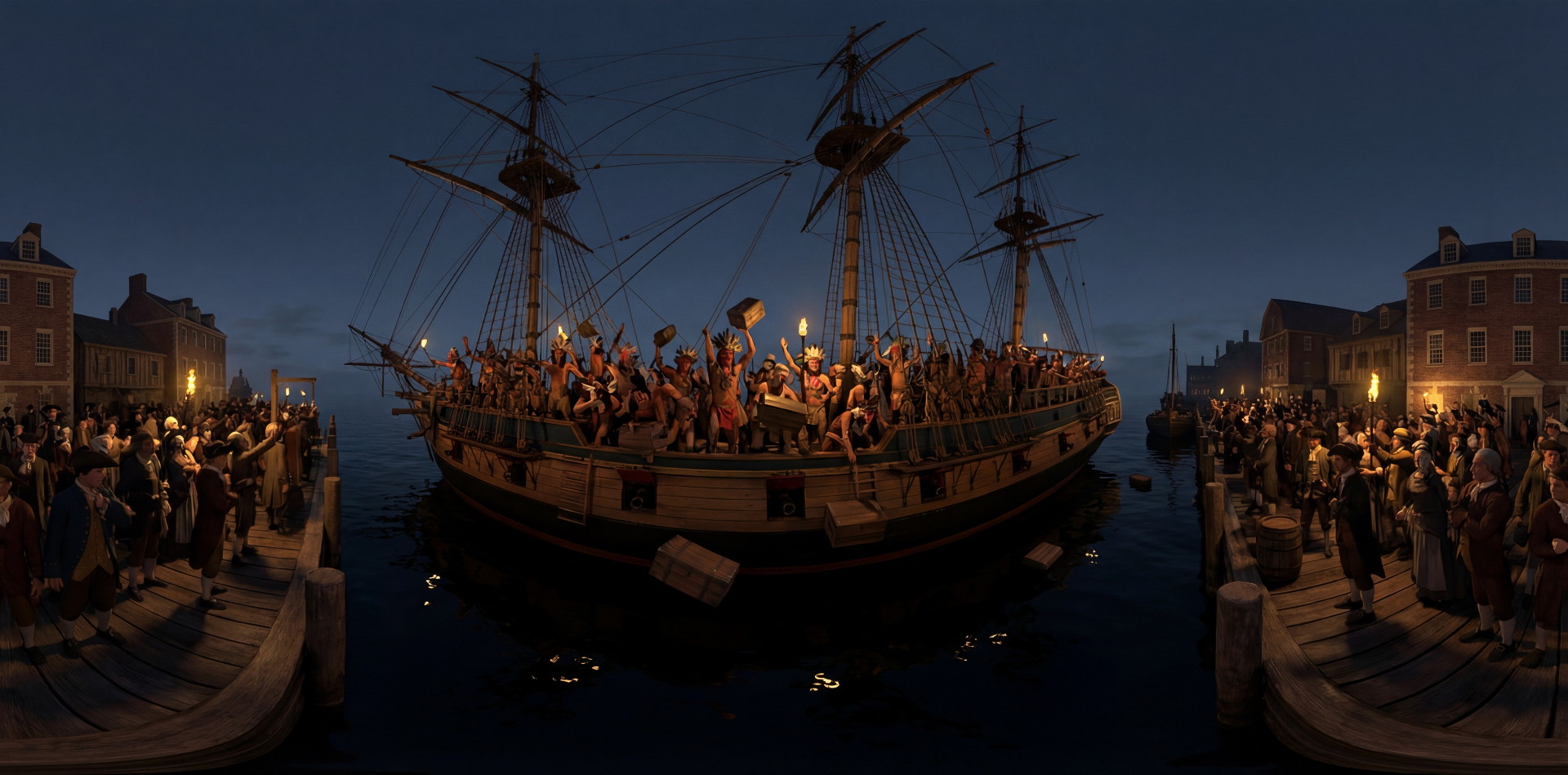
Roughly sixty men, some hastily disguised with soot and blankets as ‘Mohawks’, worked in organised parties for about three hours, splitting open 342 chests with hatchets and dumping the tea, taking care not to damage the ships or steal anything — one participant was expelled from the group for pocketing tea for himself. Among them was George Hewes, a shoemaker who later dictated a detailed memoir of the night in old age, describing how the men worked almost silently, hoisting the heavy chests on deck tackle before splitting them open with axes borrowed from the ships' own stores.
The tea chests belonged to three ships, the Dartmouth, Eleanor and Beaver, moored at Griffin's Wharf; by the following morning tea leaves had washed up along the shoreline for miles, and locals reportedly used oars to push floating clumps back out to sea. The chests came from three different Company suppliers and included Bohea, Congou and Singlo varieties, valued afterward at roughly £9,600 in the money of the day, a sum the East India Company never recovered.
This is the most magnificent movement of all. There is a dignity, a majesty, a sublimity in this last effort of the patriots that I greatly admire.
Retaliation, and escalation
Parliament's response, the Coercive Acts of 1774, closed the port of Boston until the tea was paid for, stripped Massachusetts of self-government, and quartered troops in private homes — measures colonists called the Intolerable Acts. Rather than isolating Boston, the acts pushed the other colonies toward it.
In September 1774, delegates from twelve colonies met in Philadelphia as the First Continental Congress, coordinating resistance for the first time, drafting a formal declaration of colonial rights and organising a boycott of British goods. Fighting broke out at Lexington and Concord seven months later, by which point Boston itself had spent nearly a year under military occupation and naval blockade.
The men who boarded the ships were never officially identified at the time, and participants kept the secret so completely that full lists of names were only pieced together decades later from pension records, memoirs and family tradition.
What everyone says
The Tea Party was a protest against high taxes on tea.
What the evidence says
The Tea Act actually lowered the price colonists paid for tea. The objection was to the principle of a tax imposed without their consent, not the cost.
A name attached after the fact
Contemporaries called it simply ‘the destruction of the tea’; the phrase ‘Boston Tea Party’ did not appear in print until around 1834, more than sixty years afterward, once the event had been folded retroactively into the story of the Revolution's opening act. Earlier writers had referred to it more soberly as the ‘Boston Tea Affair’ or simply the destruction at Griffin's Wharf, without any of the festive connotation the later name implies.
Griffin's Wharf itself no longer exists as a shoreline; landfill projects through the nineteenth century pushed Boston's waterfront hundreds of yards out, so the actual site of the tea dumping now sits beneath city streets some distance from today's harbour, roughly where Atlantic Avenue and the Financial District now stand.
A floating museum and replica ships now occupy a nearby berth, and one of the few tea chests believed to have survived the night, retrieved from the water afterward, remains on display there as one of the only physical relics of the episode, alongside a handful of tea leaves preserved in a glass vial that a Massachusetts family kept as a memento for generations.
How it unfolded
May 1773· the scene
Parliament passes the Tea Act, granting the East India Company direct colonial sale rights.
28 Nov 1773
The Dartmouth arrives in Boston harbour carrying dutied tea.
16 Dec 1773
The scene here: mass meeting, then the tea dumped at Griffin's Wharf.
March–June 1774
Parliament passes the Coercive Acts in retaliation.
Sept 1774
First Continental Congress convenes in Philadelphia.