A warning nobody heeded
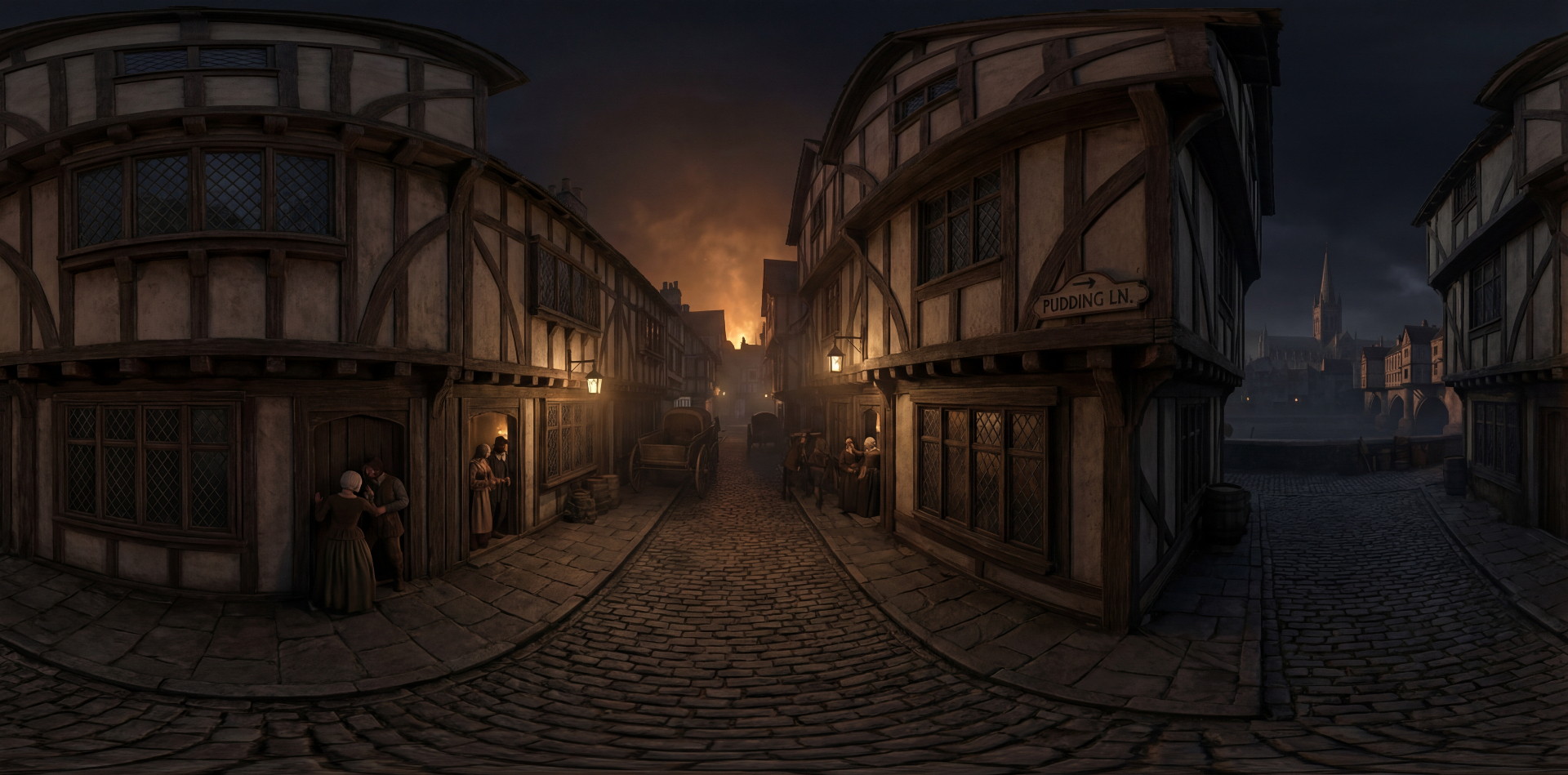
London had burned badly before — a 1633 fire on London Bridge destroyed dozens of houses — yet by 1666 the City was still built almost entirely of timber, with upper storeys jettied out over narrow streets until neighbours could nearly touch hands across the gap. A hot, dry summer had left the wood tinder-dry.
Lord Mayor Thomas Bloodworth's dismissal of the first alarm — reportedly remarking a woman could piss it out — cost the crucial early hours in which pulling down a handful of houses might have stopped it. By the time he authorised demolitions, the fire had outrun any firebreak that size.
The bakery itself, on Pudding Lane, belonged to Thomas Farriner, baker to the King's household; he and his family escaped over the rooftops, but a maidservant too frightened to climb out became the fire's first, and possibly only officially certain, victim. Farriner always insisted afterward that he had raked out his oven fire properly the night before, and no formal inquiry ever definitively established how the blaze actually started in his shop. Farriner himself went on giving evidence and testimony about the fire's origin for years afterward, still protesting his innocence of any negligence when he died in 1670.
13,200
houses destroyed
87
parish churches burned, including Old St Paul's
4 days
from outbreak to the fire being brought under control
202 ft
height of the Monument, matching its distance from the outbreak
Four days, one city
Diarist Samuel Pepys buried his parmesan cheese and a bottle of wine in his garden to save them, then rowed onto the Thames to watch the waterfront burn, writing that ‘the churches, houses, and all on fire, and flaming at once.’ The fire jumped the Fleet River and threatened the Tower of London, whose garrison used gunpowder to blast firebreaks that finally held. John Evelyn, keeping his own diary a short distance away, described London afterward as looking ‘like Sodom, or the last day’, ten thousand houses reduced in his account to smoking rubble in a matter of hours.
Old St Paul's Cathedral, its scaffolding stacked with builders' timber for ongoing repairs, went up so fiercely that its lead roof reportedly melted and ran down Ludgate Hill in the gutters. The wind that had driven the fire for three days finally dropped on 5 September, letting the firebreaks catch up.
By the time it was out, the fire in 1666 had destroyed roughly 373 acres inside the old city walls and another 63 outside them, leaving some 70,000 of the City's 80,000 residents homeless in tent camps at Moorfields and Islington through the following winter. Charles II personally rode out to Moorfields to reassure the displaced that the fire had been an accident, not a foreign plot, a public appearance chroniclers credit with heading off worse panic in the fire's immediate aftermath.
The churches, houses, and all on fire, and flaming at once, and a horrid noise the flames made.
Blame, fast and wrong
Within days, rumour blamed Catholics and foreigners for starting the fire deliberately; a mentally ill French watchmaker, Robert Hubert, falsely confessed and was hanged for it, though he had not even been in London when the fire began. The 1681 Monument inscription accusing ‘popish frenzy’ was not removed until 1830.
Christopher Wren and others submitted ambitious replanning schemes with broad avenues and piazzas; none were adopted, chiefly because rebuilding on the old property lines was faster and cheaper. What changed instead was the material: the 1667 Rebuilding Act mandated brick and stone.
A Fire Court was set up to resolve the thousands of disputes between landlords and tenants over who should pay to rebuild, settling most cases within six years — a quieter but arguably more consequential achievement than any of Wren's unbuilt boulevards. Judges sitting without juries could order a lease renegotiated or extended on the spot, a pragmatic shortcut credited with letting rebuilding proceed at a pace that surprised even contemporaries. The 1667 Act also required party walls to be built in brick to a fixed thickness according to a house's size, one of the first pieces of English legislation to standardise building safety by statute rather than local custom.
What everyone says
The Great Fire killed thousands of Londoners.
What the evidence says
Only six deaths were officially recorded, though the real toll among the poor, whose deaths went undocumented in a city with no full census, was likely somewhat higher than that.
What the ash left behind
The 1666 fire, for all its destruction, is credited by some historians with helping check the spread of the plague that had killed roughly 68,000 Londoners the year before, by burning out the crowded, rat-infested tenements where infection spread fastest, though the connection is debated rather than certain, since plague deaths had already been falling sharply in the months before the fire broke out.
Wren rebuilt 51 City churches and, over the following decades, St Paul's Cathedral itself in stone and Portland limestone, a structure that still dominates the skyline his predecessor's cathedral once did before the flames of 1666 reached it.
The Monument, a 202-foot Doric column designed by Wren and Robert Hooke, still stands close to the site of Farriner's bakery, its height calculated to equal its exact distance from where the fire began on Pudding Lane.
How it unfolded
2 Sept 1666, ~1am· the scene
Fire breaks out in Thomas Farriner's bakery on Pudding Lane.
2 Sept 1666, morning
Lord Mayor Bloodworth delays authorising demolitions.
3–4 Sept 1666
The scene here: fire spreads west, threatening St Paul's and the Tower.
5 Sept 1666
Wind drops; gunpowder firebreaks near the Tower finally hold.
1667
Rebuilding Act mandates brick and stone construction.
1677
The Monument to the fire is completed near Pudding Lane.