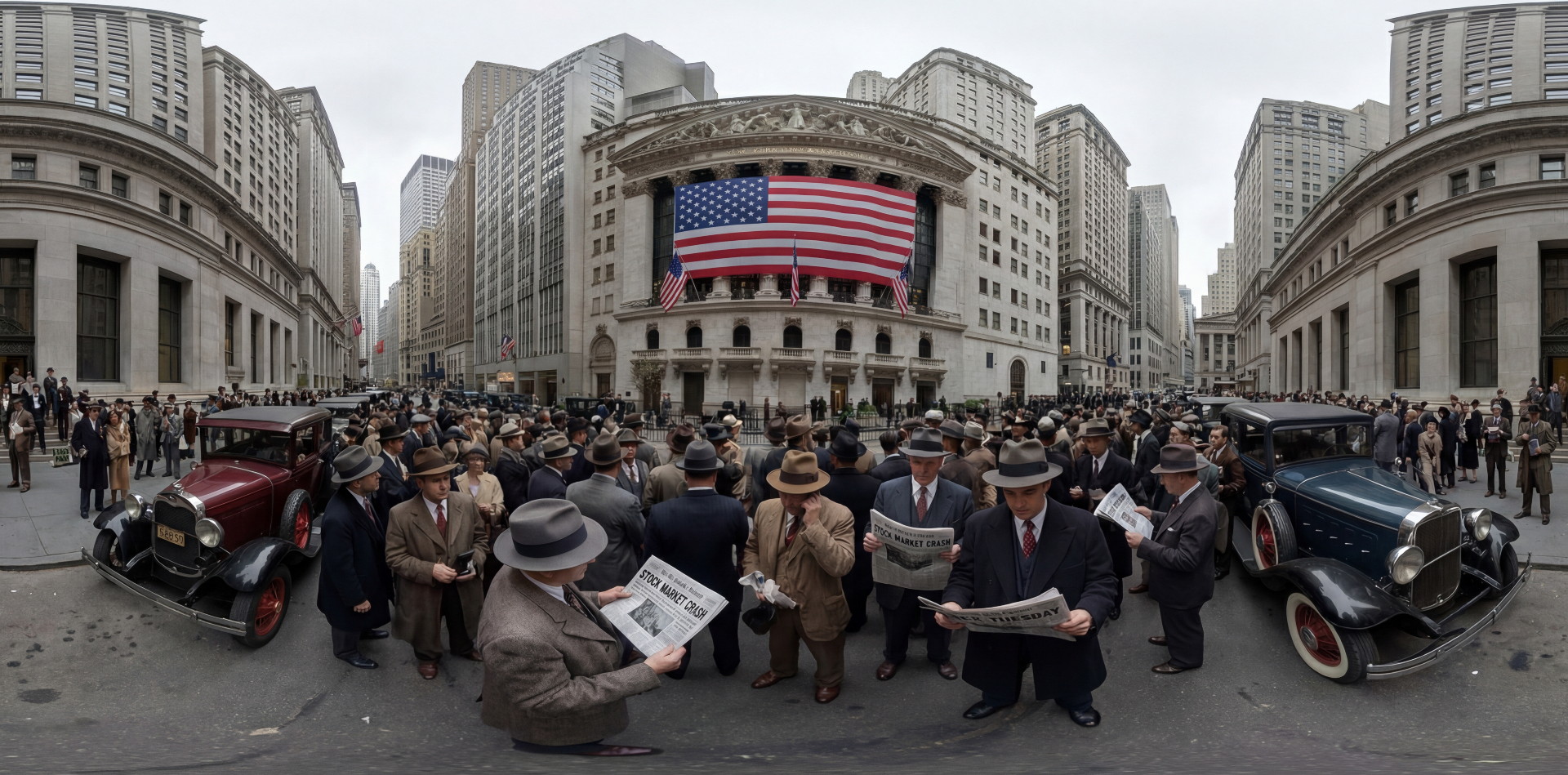
A boom built on borrowed money
Through the 1920s investors increasingly bought stock on margin, putting down as little as ten per cent of a share's price and borrowing the rest, often from brokers who themselves borrowed from banks. It let ordinary people ride a rising market with money they did not have, which worked beautifully until prices stopped rising.
The Dow had roughly quadrupled since 1921 by its September 1929 peak of 381 points. Warnings came from economists and even from within the Federal Reserve, but margin lending kept expanding and brokers' loans reached record levels through the summer, feeding a bull market that had detached from any accounting of company earnings.
Brokerage houses had multiplied along with the boom, and by 1929 an estimated one to one and a half million Americans held brokerage accounts, a small slice of the population but a far larger and more exposed one than in any previous decade, amplifying how widely a reversal would be felt. Popular magazines ran features encouraging clerks, shopkeepers and even domestic staff to buy shares on credit, a democratisation of speculation that meant the eventual losses reached far beyond professional financiers.
12.9m
shares traded on Black Thursday, 24 October
16.4m
shares traded on Black Tuesday, 29 October — a record for decades
89%
peak-to-trough fall in the Dow by July 1932
25 yrs
before the Dow regained its 1929 high, in 1954
Two days that broke the mechanism
On Black Thursday, 24 October, panic selling drove volume to 12.9 million shares, so far beyond normal capacity that the ticker fell nearly an hour and a half behind real prices. A consortium of bankers led by Thomas Lamont bought stock publicly that afternoon to calm the market, and it briefly worked. Richard Whitney, acting as the group's floor representative, walked onto the exchange and made a show of bidding well above market price for a block of US Steel, then for several other blue-chip stocks in turn, a theatrical display of confidence meant to be seen by every broker on the floor as much as to actually move prices.
It did not hold. On Black Tuesday, 29 October, 16.4 million shares changed hands, a record that stood for nearly forty years, and the ticker eventually ran so late it was printing prices from over two hours earlier, meaning nobody trading that afternoon actually knew what anything was worth.
Exchange staff worked the floor until nearly 7:30pm to clear the day's orders, and clerks were still recording transactions well past midnight; some junior employees reportedly slept at the Exchange itself rather than go home, only to return a few hours later to a paper backlog that took days to fully untangle. The Exchange did not fully catch up on paperwork until the following Saturday, five days after Black Tuesday itself.
There will be no repetition of the break of yesterday... I have no fear of another comparable decline.
The slower catastrophe
The crash alone did not cause the Depression; margin calls wiped out overleveraged investors quickly, but the deeper damage came through 1930 and 1931 as thousands of banks failed, credit dried up, and the Federal Reserve tightened rather than loosened policy, turning a stock market correction into a decade-long contraction.
By July 1932 the Dow had fallen roughly 89 per cent from its 1929 peak and would not reclaim that high until 1954. The crash's most durable legacy was regulatory: the Securities and Exchange Commission in 1934 and the Glass-Steagall Act separating commercial from investment banking, both direct responses to what had gone unchecked.
Unemployment in the United States, around 3 per cent in 1929, climbed toward 25 per cent by 1933, and the human cost — breadlines, foreclosed farms, shantytowns nicknamed Hoovervilles — dwarfed the numbers on any ticker tape from that October.
What everyone says
Ruined investors leapt from Wall Street windows on the day of the crash.
What the evidence says
This is largely newspaper invention and later folklore. Suicide rates did rise over the following years as the Depression deepened, but contemporary records show no wave of crash-day defenestrations in the financial district; most buildings' windows would not even open wide enough.
What the street looks like now
The New York Stock Exchange still occupies the same Broad Street building, its trading floor modernised repeatedly but its 1903 façade and columns essentially unchanged since the crowds pressed against them in 1929, now more often filled with tourists than panicking clerks.
Circuit breakers that automatically halt trading during steep drops, introduced after the 1987 crash and refined since, trace their logic directly back to 1929's lesson that a market without any brake can outrun the information needed to trade it safely.
The Museum of American Finance, a few blocks away, holds ticker tape, trading-floor artefacts and margin account records from the period, preserving the mechanics of a crash whose broader lesson — cheap borrowed money inflating asset prices — has recurred in nearly every decade since. The Dow's low point came on 8 July 1932 at 41.22, a level that meant an investor who had bought at the 1929 peak had lost close to ninety per cent of their money, and the index did not close above its September 1929 high again until 23 November 1954, nearly a quarter-century on.
How it unfolded
September 1929· the scene
The Dow Jones Industrial Average peaks at 381.17.
24 October 1929
The scene here: Black Thursday panic; bankers intervene to buy stock.
28 October 1929
Black Monday: the Dow falls nearly 13 per cent.
29 October 1929
Black Tuesday: record volume, the crash's worst single day.
1930–1933
Thousands of US banks fail as the Depression deepens.
1933–1934
Glass-Steagall and the SEC are created to regulate what caused the crash.