Forty-five seconds and a ruptured city
At 5:12 in the morning on 18 April 1906, a rupture along the San Andreas Fault tore for roughly 470 kilometres of the California coastline, most violently near San Francisco itself, where the fault runs directly beneath parts of the city. The shaking lasted under a minute but was severe enough to topple unreinforced brick and masonry buildings across downtown and shear water mains at literally dozens of points, including the main trunk lines feeding the fire department's hydrants, leaving crews with almost nothing to fight the fires that followed.
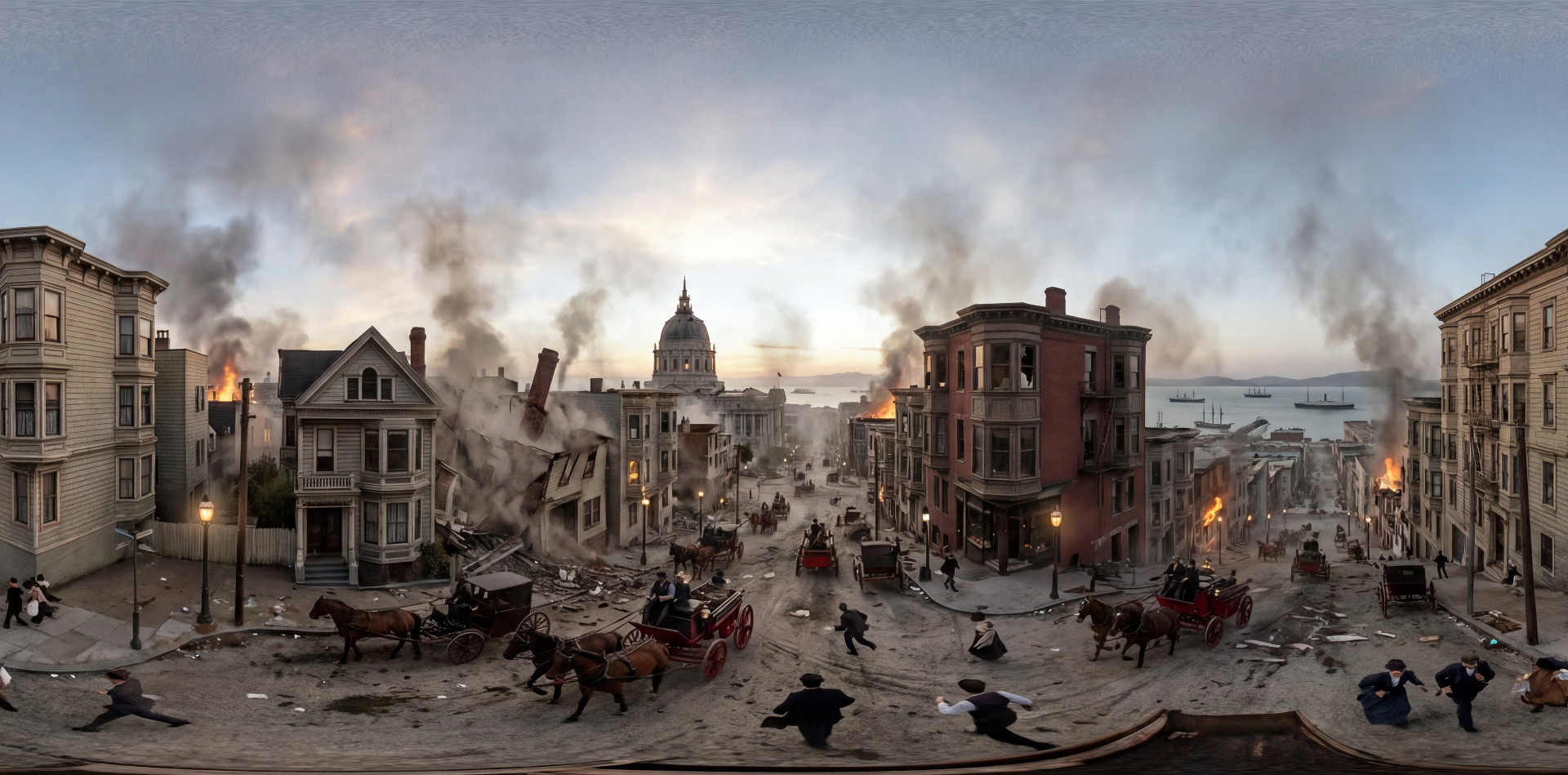
City Hall's dome, part of a building that had cost roughly six million dollars and taken 27 years to complete, was left a stripped iron skeleton within seconds, its ornamental stonework shaken clean off the frame — a widely photographed image that came to stand for the earthquake itself, even though the fire that followed in its wake ultimately destroyed far more of the city than the initial shaking ever had.
Fire chief Dennis Sullivan, the one official whose department had actually drilled for exactly this scenario and had warned for years that the city's water system was inadequate, was fatally injured within minutes of the quake when a collapsing chimney from the neighbouring California Hotel crushed through the ceiling of the fire station where he slept, dying three days later and removing the department's most experienced leader before the fires had even properly taken hold.
7.9
estimated moment magnitude
~470 km
length of the surface rupture along the San Andreas Fault
3 days
the fire burned before being fully contained
3,000+
modern estimated death toll, against an official 375
Fighting fire without water
With mains broken across downtown, firefighters had almost no pressure to draw on and resorted to dynamiting buildings along whole streets to create firebreaks, a tactic that sometimes worked and sometimes simply started fresh fires from poorly placed or oversized charges. The separate blazes converged into one enormous fire and burned largely unchecked for three days, consuming close to 500 city blocks and an estimated 28,000 buildings before it finally burned itself out.
Army troops from the Presidio, under General Frederick Funston, were deployed within hours to help police the ruins and assist the firebreak effort, controversially under Mayor Eugene Schmitz's proclamation authorising police and soldiers to shoot looters on sight — an order that likely killed some innocent bystanders caught in the chaos and remains one of the disaster's more disputed and least examined episodes.
Some residents saved their own blocks by soaking blankets and rugs in wine or vinegar drawn from cellar stocks when water ran out entirely, and the tenor Enrico Caruso, in town for a Metropolitan Opera tour, reportedly fled the Palace Hotel in his pyjamas clutching a signed photograph of Theodore Roosevelt, vowing never to return to the city. Such improvisations are repeated often enough in survivor accounts that historians treat the wine-soaked blankets as a genuine, if desperate, firefighting method rather than folklore.
San Francisco is gone. Nothing remains of it but memories.
A city that undercounted its own dead
Officials reported 375 deaths at the time, a figure historians now regard as a deliberate undercount meant to reassure investors and protect the city's reputation for insurance and reconstruction financing purposes. Modern research, cross-referencing Chinatown records that white officials largely ignored or never collected in 1906, puts the true toll above 3,000, with the Chinese community in particular badly undercounted amid contemporary racial prejudice.
More than half the city's roughly 400,000 residents were left homeless, sheltering in makeshift tent camps and later in some 5,300 specially built earthquake cottages across Golden Gate Park and the Presidio for months, some families remaining in them for years while downtown was rebuilt. The earthquake also produced Harry Fielding Reid's elastic-rebound theory, the first scientific model explaining how stress along a fault builds up and then releases in a sudden rupture.
Insurance claims from the fire damage, rather than the earthquake itself, drove much of the rebuilding finance, since many standard fire policies of the day excluded earthquake damage outright and insurers had every incentive to attribute losses to fire instead. Some companies, including several British firms, paid out in full anyway to preserve their reputation for reliability, while at least one American insurer went bankrupt trying to meet its obligations.
What everyone says
The earthquake itself destroyed most of San Francisco.
What the evidence says
Structural damage from the shaking was serious but limited; the fire that followed, spread by broken gas lines and fought without water because mains had failed, destroyed roughly eighty percent of the city over three days.
Rebuilt within years, remembered in fault lines
San Francisco rebuilt with startling speed: much of the devastated downtown area was reconstructed within roughly three years, driven by real-estate pressure and civic pride in equal measure, well ahead of the 1915 Panama-Pacific International Exposition the city deliberately staged, on reclaimed land at the Marina district, specifically to show the world it had fully recovered from the disaster.
Reid's elastic-rebound theory, developed directly from geodetic surveys of ground displacement along the 1906 rupture, remains the basic model seismologists use today to explain how stress accumulates along a locked fault before releasing suddenly in an earthquake, making this disaster genuinely foundational to the modern science of seismology rather than only a civic tragedy remembered in local history.
The Loma Prieta earthquake of 1989, magnitude 6.9 and centred on a nearby segment of the same fault system, killed 63 people and is still routinely measured against the far larger 1906 event in California emergency planning documents, a comparison that keeps the older disaster central to how the Bay Area continues to prepare, through building codes and retrofitting programmes, for the next major rupture.
How it unfolded
5:12am, 18 Apr 1906· the scene
Rupture begins; severe shaking lasts under a minute.
Morning, day one
Broken mains leave firefighters without water pressure.
Day one
The scene here: dynamited firebreaks along Van Ness Avenue.
20 Apr 1906
The fire is finally brought under control after three days.
1908
Harry Fielding Reid publishes elastic-rebound theory based on the rupture.
1915
San Francisco hosts the Panama-Pacific Exposition to showcase its recovery.