Tonnage rules, not passenger counts
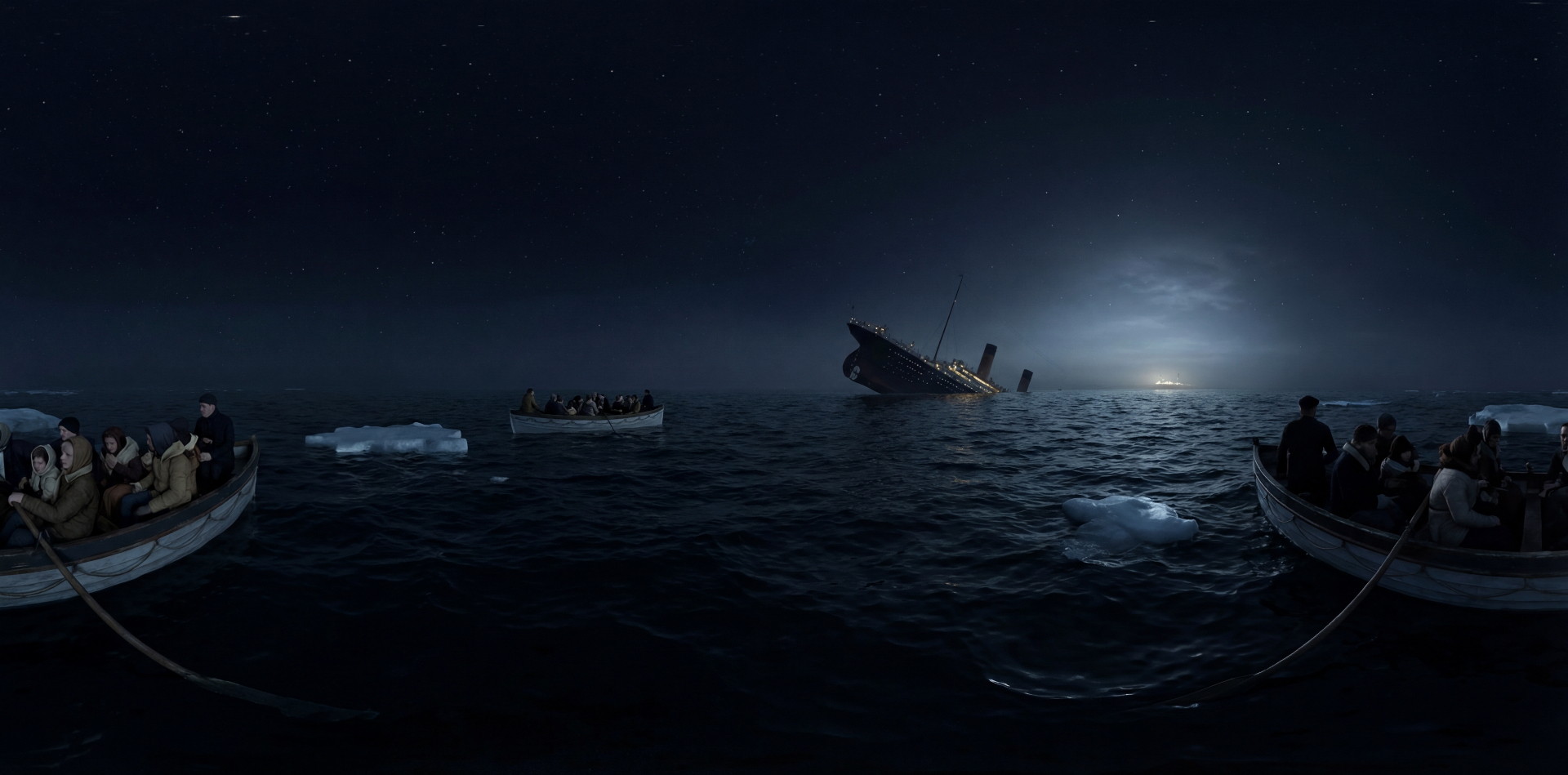
British Board of Trade regulations calculated required lifeboat capacity from a ship's gross tonnage rather than the number of souls aboard, a formula last updated in 1894 when the largest liners on the Atlantic run were a fraction of Titanic's 46,328 tons. By the letter of the law Titanic could have sailed with even fewer boats than the sixteen wooden and four collapsible boats she carried — twenty in all, enough for roughly 1,178 people against 2,224 aboard — and White Star still exceeded the legal minimum voluntarily.
The assumption underpinning the whole system was that lifeboats existed to ferry passengers in relays to a rescuing ship nearby, not to hold everyone afloat simultaneously — a reasonable premise in busy shipping lanes that failed completely on a night when the nearest ship, the Californian, roughly ten miles off, had already shut down its wireless set for the night and its officers misread Titanic's distress rockets as routine signalling rather than a call for help.
White Star's managing director, J. Bruce Ismay, was aboard and later faced fierce criticism, in both the American Senate inquiry chaired by Senator William Alden Smith and the British Wreck Commissioner's inquiry led by Lord Mersey, for climbing into collapsible lifeboat C while women and children from third class remained belowdecks. The American press nicknamed him ‘J. Brute Ismay,’ and the controversy shadowed him until his death in 1937.
2,224
estimated total aboard
~1,500
estimated deaths
20
lifeboats and collapsibles carried, against capacity for roughly half those aboard
2h 40m
time from collision to the ship going under
A collision nobody was braced for
The iceberg was struck at 11:40pm on 14 April 1912, some 37 seconds after lookout Frederick Fleet, working without binoculars because the ship's only pair had been mislaid in Southampton, rang the crow's-nest bell three times and telephoned the bridge with ‘Iceberg, right ahead.’ The glancing blow along the starboard bow popped rivets and buckled plates across roughly 300 feet, opening five of the ship's sixteen watertight compartments to the sea — one more than her design could survive while staying afloat.
Many of the earliest lifeboats launched partly empty — boat No. 7 left with around 28 people in a boat rated for 65, and No. 1 carried just 12 — because crew and passengers alike found it difficult to believe the ship, popularly if never officially billed as practically unsinkable, was actually going down on a night so calm the sea showed no swell to help oarsmen judge distance from the hull.
Six separate ice warnings reached Titanic's wireless room on 14 April, from the Caronia, Baltic, Amerika, Californian and Mesaba among others, several naming the exact latitude and longitude of field ice and bergs directly in the ship's path. Wireless operators Jack Phillips and Harold Bride, swamped clearing a backlog of paying passengers' personal messages via Cape Race, did not relay the Californian's final and most urgent warning, sent at around 11pm, to the bridge before the collision.
Nearer, my God, to Thee.
A four-hour race and a permanent rulebook
The Cunard liner Carpathia, roughly 58 miles away under Captain Arthur Rostron, received Titanic's distress call just after midnight and steamed through ice fields at a dangerous 17 knots for nearly four hours, arriving around 4am to begin pulling survivors from the lifeboats by lamplight. Of an estimated 2,224 aboard, about 705 survived; close to 1,500 died, most within minutes from hypothermia in water measured near 28 degrees Fahrenheit, well below the point at which the body can sustain consciousness.
The disaster produced the 1914 International Convention for the Safety of Life at Sea (SOLAS), the first version of a treaty still amended today, mandating lifeboat space for every person aboard, continuous 24-hour radio watch on passenger ships, and the founding of the International Ice Patrol, funded by contributing nations, to track and report North Atlantic bergs each season. The wreck itself was not located until 1 September 1985, by Robert Ballard's expedition, nearly 3,800 metres down.
Survival rates split sharply by class and gender: roughly 97 percent of first-class women survived, versus about 46 percent of third-class men and only around 27 percent of third-class passengers overall, many of whom faced longer, more confusing routes up from lower decks to the boats. Both the British and American inquiries examined the disparity closely, and later historians treat the numbers as a stark, quantified record of Edwardian class hierarchy holding even as the ship went down.
What everyone says
White Star Line publicly advertised Titanic as unsinkable.
What the evidence says
The claim traces mostly to a trade publication describing the design as 'practically unsinkable' due to its watertight compartments, a phrase the press later amplified into an official boast the company itself never quite made.
A wreck that rewrote maritime law
The British and American inquiries that followed within weeks — Senator Smith's beginning in New York just four days after the sinking, Lord Mersey's opening in London that May — produced conflicting verdicts on individual blame but agreed on the practical failures: too few lifeboats, an unheeded ice warning, and a nearby ship, the Californian, that never came to help. Both bodies recommended reforms that fed directly into the 1914 SOLAS convention within two years.
Robert Ballard's 1985 discovery of the wreck, split into a bow and stern section nearly 600 metres apart on the ocean floor and surrounded by a debris field of boilers, dishware and personal effects, confirmed that the ship broke in two before sinking — a detail survivors had reported at the time but which official inquiries, lacking physical evidence, had largely dismissed for more than seventy years.
The site is now protected under a 2012 UNESCO-linked international agreement limiting salvage and restricting the removal of artifacts, and pieces already recovered before that date — from a chandelier to unopened bottles of champagne and a fragment of the hull itself — are held in museum collections rather than private hands, a compromise between preservation and the disaster's enduring public fascination more than a century on.
How it unfolded
10 Apr 1912· the scene
Titanic departs Southampton on her maiden voyage.
11:40pm, 14 Apr
The scene here: collision with the iceberg on a flat calm sea.
12:05am, 15 Apr
The order is given to uncover and load the lifeboats.
2:20am, 15 Apr
Titanic sinks, roughly two hours forty minutes after impact.
4:10am, 15 Apr
Carpathia begins picking up survivors from the lifeboats.
1914
The first SOLAS convention rewrites international lifeboat and radio rules.