A patina that protects rather than decays
The statue's copper sheeting is thinner than two stacked pennies, and by 2011 it had already spent 125 years converting, molecule by molecule, into the mineral crust that gives it its colour. Copper carbonate, the same chemistry that greens old pennies and church roofs, forms an unusually stable seal once it sets, which is why the underlying metal below the surface remains largely undamaged.
Conservators who inspected the statue ahead of its 2011–12 closure found that the real wear was not in the copper skin but in the iron armature bolted to it from inside — an engineering choice by Gustave Eiffel that let dissimilar metals grind against each other for a century, accelerated wherever rainwater pooled.
That grinding, known as galvanic corrosion, had already forced one full replacement of the armature during the 1980s restoration; asbestos-laden insulation meant to separate the copper and iron had failed decades earlier. By 2011 engineers were monitoring the newer stainless-steel ribs for early signs of the same problem, this time with sensors rather than guesswork.
125
years old on 28 October 2011
3/32 in
thickness of the statue's copper skin
240
daily crown visitors permitted under post-2001 fire codes
1 yr
length of the stair and safety closure that began the day after
A gift measured in francs and pennies
France funded the statue itself, roughly 250,000 francs raised through public subscriptions, lotteries and a Bartholdi-designed fundraising campaign, while the American side was responsible for the pedestal. That effort stalled until publisher Joseph Pulitzer shamed his readers into action through the New York World, ultimately collecting more than $100,000 from over 120,000 small donors, many giving less than a dollar. Pulitzer printed every donor's name in the paper, however small the sum, a stunt that turned the pedestal fund into a running public spectacle rather than a quiet charity appeal.
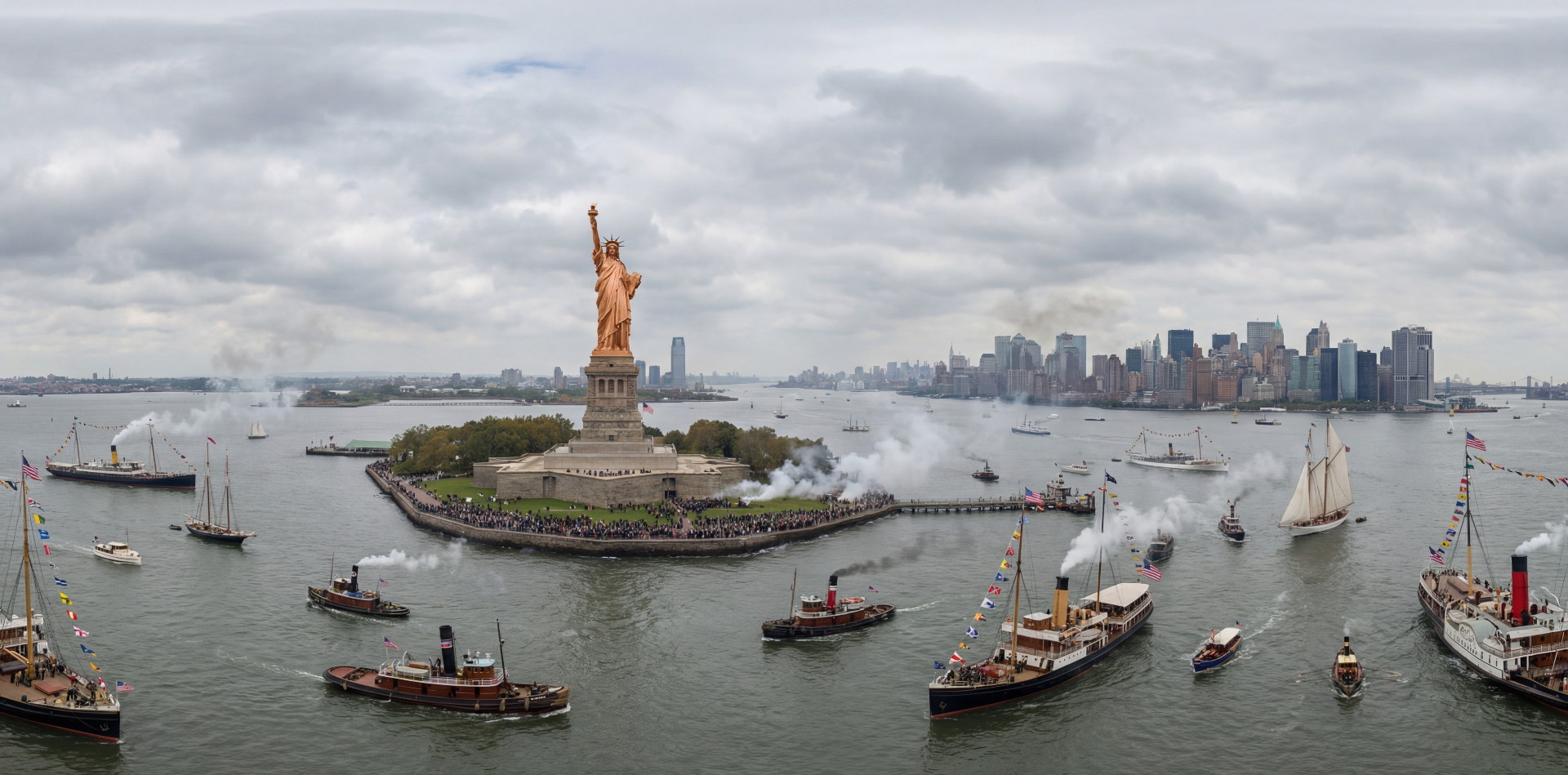
Gustave Eiffel, fresh off his tower's fame, engineered the internal iron skeleton that let Bartholdi's thin copper skin flex slightly in wind rather than crack under it, a solution borrowed from the same principles he used in bridge trusses. The completed statue was shipped from France in 214 packing crates and reassembled on Bedloe's Island in four months during 1886, a dedication ceremony on 28 October attended by President Grover Cleveland amid a flotilla of steamships and a fog so thick that much of the harbour crowd never actually saw the unveiling.
That layered origin — French sculpture, French engineering, American money and land — meant the statue arrived already carrying a story about shared effort, one the National Park Service leaned on heavily when planning the 125th anniversary rather than treating it as simply a birthday for a building. The contrast with 1886 was deliberate: where the original dedication had been a formal, largely closed civic occasion, the 125th anniversary was built around live streaming and a naturalisation ceremony meant to put ordinary visitors at the centre of the story.
For the first time ever, you can see a view from the torch looking down towards her crown, face, tablet and historic Fort Wood all from your computer or smart phone.
A monument that keeps being repurposed
The 1986 centennial restoration had already replaced the original torch flame, the corroded iron ribs, and much of the interior stairway, so the statue marking its 125th year was, mechanically, a fairly young structure wearing a very old skin. What the anniversary added was digital: webcams installed in the torch that year streamed a live harbour view to the internet for the first time, turning a nineteenth-century gift into a twenty-first-century broadcast.
The anniversary also folded in a piece of civic ritual that has nothing to do with copper at all — dozens of immigrants were sworn in as new US citizens on Liberty Island that October, a naturalisation ceremony the National Park Service now holds there most years, deliberately tying the statue's meaning to the ongoing fact of immigration rather than to 1886 alone.
EarthCam, the company that built the torch cameras pro bono with the Statue of Liberty-Ellis Island Foundation, rigged five separate feeds: three panoramas of the harbour skyline and two looking back at the crown, tablet and Fort Wood below, the first views from that vantage since the torch closed to the public in 1916.
What everyone says
The statue's green colour means the copper is corroding away.
What the evidence says
The verdigris patina is a stable mineral layer that forms once and then protects the copper beneath it from further loss — the statue actually corroded fastest in its first few decades, before the patina fully developed.
Security closed what corrosion never did
The crown reopened to visitors in 2009 for the first time since the September 11 attacks, but only 240 people a day were allowed up the narrow original staircase, a limit set by fire-safety codes rather than by the statue's condition. The day after the 125th-anniversary celebrations, the crown closed again, this time for a scheduled year of stairwell, elevator and life-safety work rather than any new damage.
That closure is a reminder of how much of the statue's modern story is about access and security rather than the monument itself. Liberty Island has been searched, screened and rerouted more times since 2001 than in the previous century combined, while the statue at its centre has changed comparatively little.
When the crown reopened again in October 2012, superstorm Sandy flooded Liberty Island within days and shut the whole site for eight more months, underscoring how often the statue's calendar has been set by weather, security and politics rather than by any failing in Bartholdi's original copper.
How it unfolded
1886
Statue dedicated on Bedloe's Island (later renamed Liberty Island).
1916
The Black Tom explosion damages the arm; the torch closes for good.
1986
Centennial restoration replaces the torch and much of the internal ironwork.
2001
The statue and island close to visitors after the September 11 attacks.
28 Oct 2011· the scene
125th anniversary: naturalisation ceremony and torch webcams — the scene here.
29 Oct 2011
Crown closes for a year of stair and safety renovation.