Nobody knew it was a volcano
Vesuvius had been quiet for centuries. Its slopes were prime vineyard land, and the towns beneath it were wealthy precisely because the soil was so good. When earthquakes shook the bay in AD 62 and again in the years after, the damage was read as an inconvenience — temples were still under repair when the eruption came.
The first phase dropped pumice for around eighteen hours. It was survivable, and many people left. The ones who stayed sheltered indoors, which was the reasonable thing to do about falling stone and exactly the wrong thing to do about what came next.
Pompeii in 79 was a working port town of perhaps twelve thousand people, with bakeries, a laundry, brothels and a recently repaired forum. Its economy ran on wine and garum, the fermented fish sauce shipped in amphorae stamped with local makers' names, some of which still turn up sealed and intact. One local producer, Umbricius Scaurus, branded his garum jars widely enough that his amphorae have turned up as far away as southern France, evidence of a genuinely export-scale local industry. The AD 62 earthquake had cracked open temples, toppled statues and left the Basilica and the Temple of Isis mid-repair seventeen years later, with scaffolding still standing in several public buildings; wall paintings in some houses even show the earthquake itself, gods and buildings tilting sideways, evidence Pompeians had started commemorating the disaster before the mountain finished the job.
~18 hrs
of pumice fall before the first deadly surge
4–6 m
of ash and pumice covering the town
300°C+
estimated surge temperature at Pompeii
1,150+
victims recovered so far, from perhaps 12,000 residents
The surges
When the eruption column collapsed, it sent pyroclastic surges down the mountain: ground-hugging clouds of gas and ash moving faster than a car and hot enough to kill instantly. Herculaneum was hit first, Pompeii in the early morning of the second day.
The famous plaster casts are not bodies. They are the voids left where flesh decayed inside hardened ash, filled with plaster by Giuseppe Fiorelli from 1863 — which is why they capture cloth folds, sandal straps and the shape of a hand over a face.
Skeletal analysis of victims at Herculaneum's boat sheds shows fractures and charring consistent with instant death from extreme heat, likely several hundred degrees Celsius for a fraction of a second. Pompeii, further from the crater, was buried more by ash fall and later, cooler surges — which is why it preserved buildings that Herculaneum's superheated blast simply carbonised. Wooden furniture, doors and even a baby's cradle survived at Herculaneum precisely because the heat carbonised rather than incinerated the wood, sealing its shape in black char. Geologists reading the deposits in cross-section separate the eruption into distinct layers: white pumice from the opening Plinian phase, grey pumice as the magma chemistry changed, then surge deposits proper, fine ash laid down in thin, cross-bedded sheets by clouds fast enough to strip roof tiles — layering precise enough that volcanologists count at least six separate surge and flow events at Pompeii alone.
You could hear the shrieks of women, the wailing of infants, and the shouting of men... many besought the aid of the gods, but still more imagined there were no gods left.
An accidental archive
Ash sealed the town within a day, and that seal is why Pompeii matters. Loaves still in ovens. Election slogans painted on street walls. Graffiti about who loved whom, who owed money, and who thought the wine was watered. Nowhere else preserves the ordinary Roman day at this resolution.
Pliny the Younger, watching from Misenum across the bay, wrote the only surviving eyewitness account of the eruption that killed his uncle. Volcanologists still call this kind of event Plinian, after an eighteen-year-old's letters to Tacitus.
Pliny the Elder, commander of the fleet at Misenum, sailed toward the eruption to rescue friends and study it at close range, and died at Stabiae, apparently overcome by fumes on the shore. His nephew's two letters, written some twenty-five years later at Tacitus's request, remain the closest thing history has to a field report from inside a volcanic disaster. The younger Pliny, only seventeen or eighteen at the time, stayed behind at Misenum reading Livy by lamplight while ash fell on the town, a detail he later admitted his mother found almost as alarming as the eruption itself.
What everyone says
It happened on 24 August AD 79.
What the evidence says
That date comes from one contested line in a medieval copy of Pliny. Autumn fruit in the debris, braziers set up in houses, heavier clothing on victims, and a charcoal inscription dated to mid-October all point to an eruption in the autumn instead.
Nineteen centuries under ash
Systematic excavation began in 1748 under Spanish Bourbon patronage, initially treated as treasure-hunting for royal collections rather than archaeology; proper stratigraphic recording did not arrive until Fiorelli took charge in the 1860s. Roughly a third of the site remains unexcavated today, deliberately left for future techniques.
Modern work has moved from digging to diagnosis: CT scans of plaster casts have shown healed fractures and dental evidence about diet, and DNA testing has overturned assumed family relationships among victims found together. The eruption froze a single afternoon, but the questions it can still answer keep expanding.
Pompeii and Herculaneum together draw several million visitors a year, walking streets with cart ruts still worn into the paving stones. The mountain that buried them is still active, with roughly three million people now living within reach of an eruption on the same scale.
How it unfolded
AD 62
A major earthquake damages Pompeii; repairs are still unfinished in 79.
Morning, day one
The column rises; Pliny the Elder sails from Misenum to help.
79· the scene
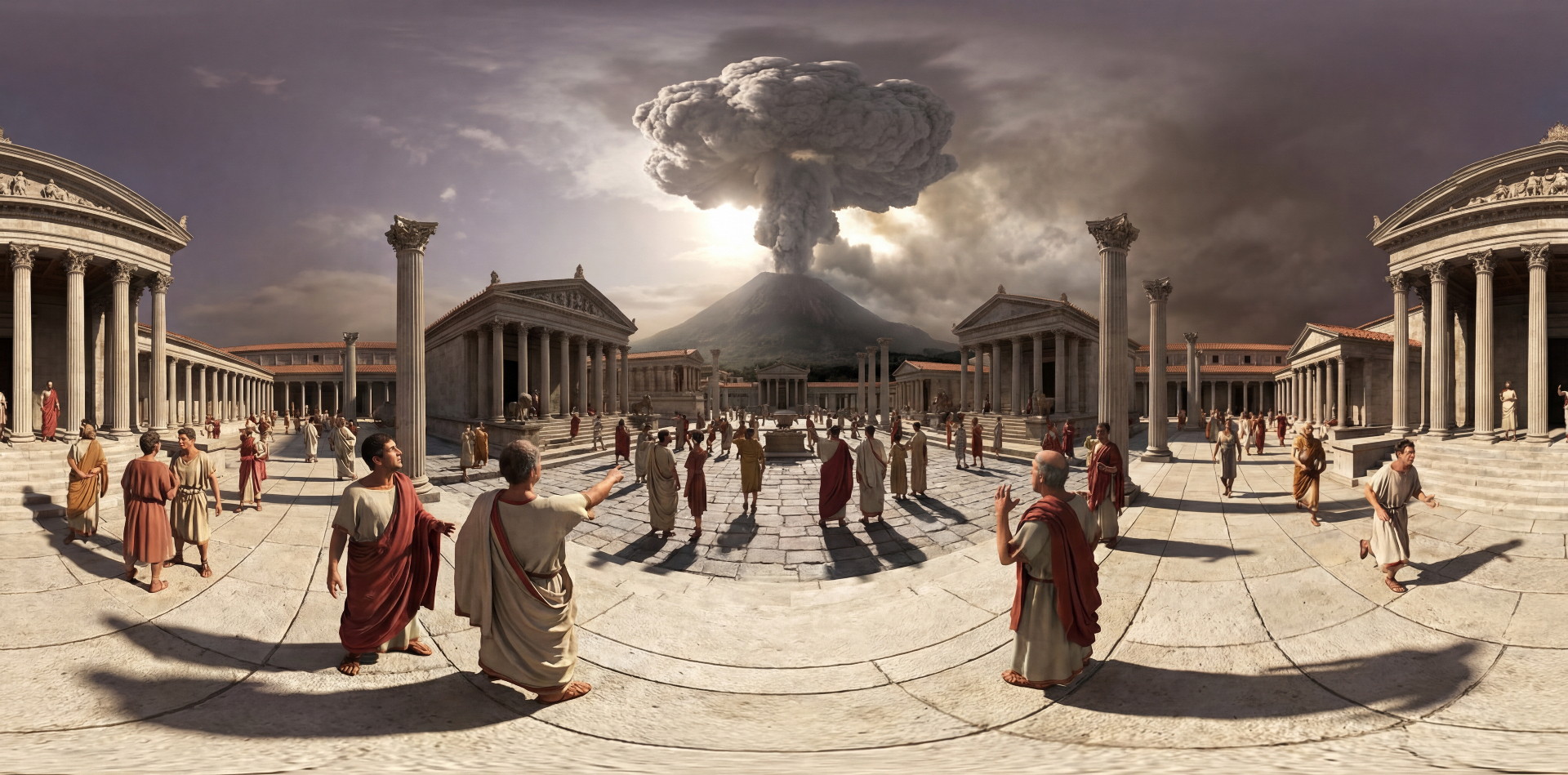
The scene here: pumice fall thickens over the town and roofs begin to collapse.
Night
The column collapses; surges destroy Herculaneum.
Dawn, day two
A surge reaches Pompeii. The town is sealed within hours.
1748
Bourbon excavators begin systematic digging at the site.