50 Historical Moments You Can Explore in 360°
Every scene in HistoryGuesser is a real, dated event with real coordinates — from the Great Pyramid rising above the Nile floodplain in 2570 BC to the Burj Khalifa topping out over Dubai in 2008. Each one has a page here: what it was like to stand there, how the moment unfolded, the visual clues that date it, and the thing most people get wrong.
- stories
- 50 stories
- words of history
- 51,536 words of history
- questions answered
- 150 questions answered
Find a scene
6 of 50
Period
Kind of event
6 scenes · Engineering marvels · Industrial age
6 scenes · Engineering marvels · Industrial age
Read the Engineering marvels collection →Industrial age(6 of 17)
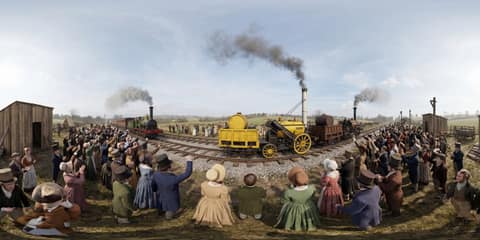 1830🇬🇧 the United Kingdom 4 min read
Opening of the Liverpool and Manchester Railway
Britain's fastest transport had been a canal barge at four miles an hour. Fifteen months later a passenger train was outrunning the Duke of Wellington's own coach, and killing a cabinet minister on opening day.
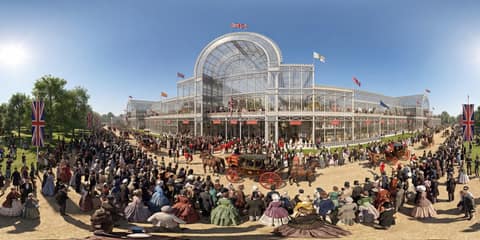 1851🇬🇧 the United Kingdom 4 min read
The Great Exhibition at Crystal Palace, London
A greenhouse-builder with no formal architectural training designed the largest glass building on Earth, and had it finished from a standing start in about six months.
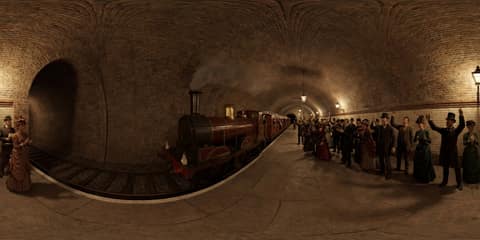 1863🇬🇧 the United Kingdom 4 min read
Opening of the Metropolitan Railway, World's First Underground
London solved its traffic problem by tunnelling under it, then filled that tunnel with coal-burning steam locomotives and asked passengers to breathe the result for the next quarter century.
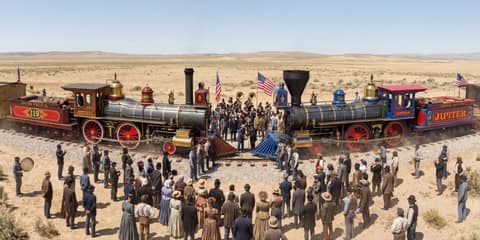 1869🇺🇸 the United States 5 min read
Golden Spike Ceremony, Promontory Summit
Two railroads raced past each other building parallel grades for months because neither had been told where to actually meet, until Congress finally forced a single junction point.
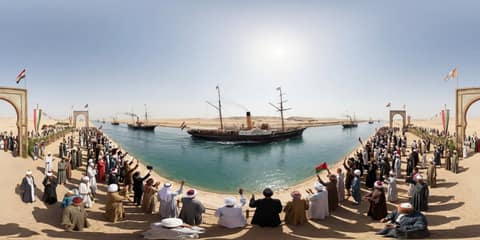 1869🇪🇬 Egypt 4 min read
Opening of the Suez Canal
Ferdinand de Lesseps had never built anything before this, Britain tried to sabotage the project twice, and the canal still opened only sixteen months behind schedule.
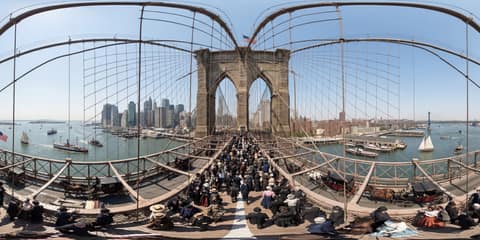 1883🇺🇸 the United States 5 min read
Brooklyn Bridge Grand Opening
A bridge two men designed and a third finished by signalling letters from a sickbed with a telescope trained on the towers she could not climb herself.
Frequently asked questions
What is a HistoryGuesser moment?
A single documented event or scene recreated as a 360° panorama — the Parthenon mid-build in 430 BC, Pudding Lane burning in 1666, the Beatles on a Mayfair roof in 1969. Each one is a round in the game and a page here with the full story, the visual clues and a short Q&A.
How long is each story?
Most run about a thousand words — a five-minute read. Every one follows the same shape: what you would have seen standing there, how the moment unfolded, a contemporary quote, the figures that matter, a dated timeline and the thing most people get wrong about it. The read time is printed on every card below.
How accurate are the scenes?
Every moment is tied to a dated, documented event with real coordinates. The panoramas are reconstructions rather than photographs — most of these scenes predate photography — but the architecture, technology and clothing are researched to the year shown.
Can I use these pages for teaching?
Yes. The clue lists work well as source-analysis prompts, the questions and answers work as a worksheet, and the game itself is free with no account required for the first rounds.
How do I play a specific moment?
Start a game from the home page and the library shuffles moments into your rounds. The daily challenge serves five fresh scenes every day, and country collections group moments by where they happened.
Can I filter the library?
Yes — the bar at the top of this page narrows the library by period, kind of event and country, and the search box matches titles, places, years and the clues themselves. Every combination is a real URL, so a filtered view can be bookmarked or sent to someone else, and once you have read a few stories you can hide them and see only what is left.
More free history games
Scored quizzes, a printable trivia bank and country collections — all free, no sign-up.