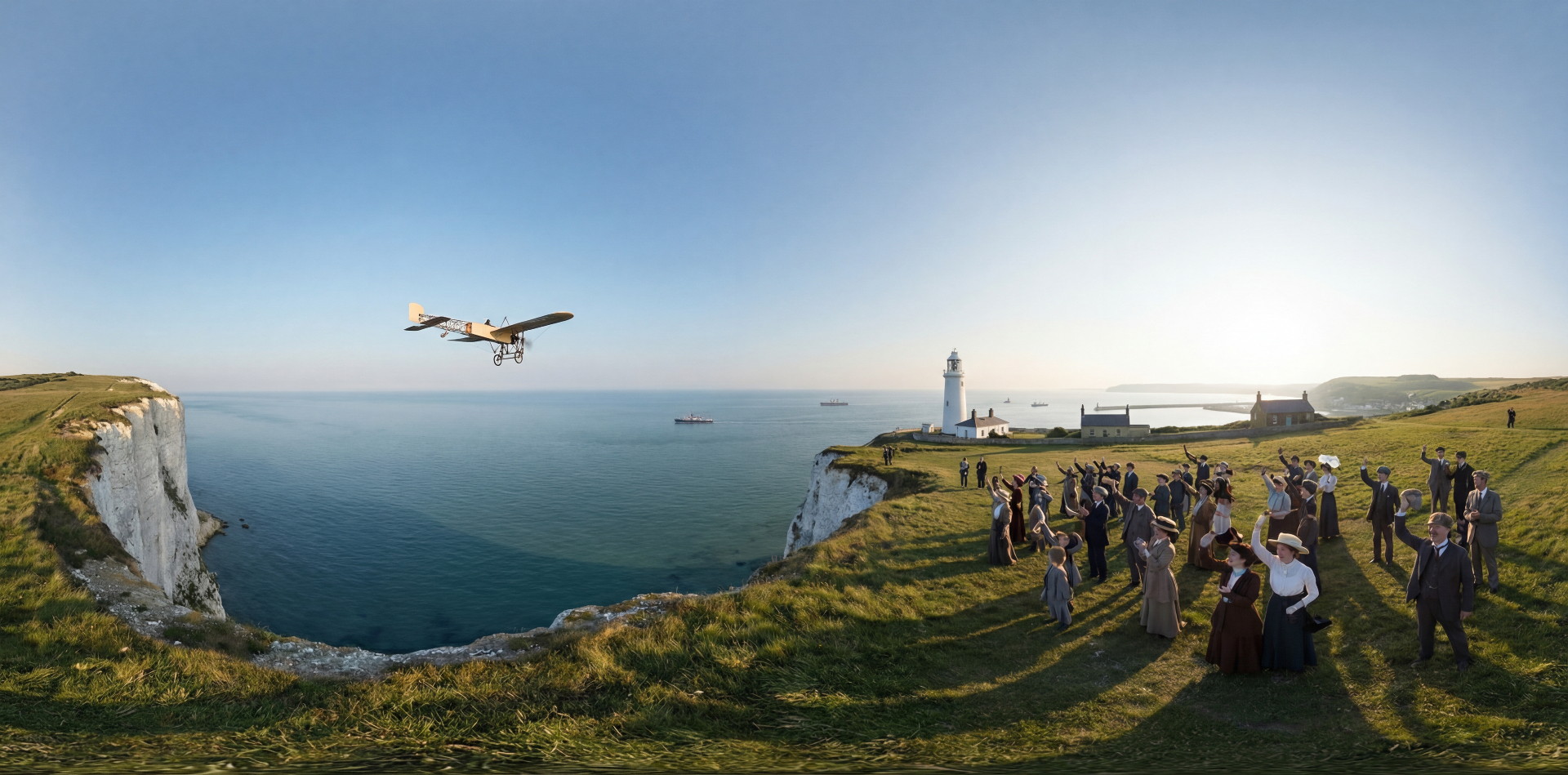
One historical scene a day, five guesses at the year, about ninety seconds. No map, no timer, no sign-up — look around the panorama, read the clues it gives you, and narrow the date down. Every wrong guess says earlier or later and unlocks a new hint.
Puzzle #94
5 guesses left
Drag to look around
Select era
Antiquity1000Modern day
Every wrong guess unlocks a clue — and tells you whether the real year is earlier or later.
How to play
1
Look around the scene. It is a full 360° panorama, so drag it — the dating evidence is often behind you.
2
Set a year with the slider, the arrows or by typing straight into the box. BC years are fine: type "500 BC" or just a minus sign.
3
Submit. If you are wrong you are told whether the real year is earlier or later, roughly how far off you are, and you unlock a clue.
4
Five guesses in total. Older scenes count as correct within a wider window, because nobody dates a Bronze Age harvest to the exact year.
5
Solve it and share the grid — it shows how close each guess was without spoiling the answer.
How to date a scene: the cheat sheet
Guessing the year is not trivia — it is reading evidence. Almost every scene contains three or four things that could only exist inside a particular window, and the skill is spotting the narrowest one. Here is what to look at, period by period.
Before 500
Ancient world
Look at how stone is cut and lifted: dressed blocks with lifting bosses still attached mean the building is unfinished, which pins the scene to a construction decade rather than the monument's whole life.
Column orders move slowly but visibly — heavy Doric gives way to slimmer Ionic and then acanthus-leaf Corinthian across roughly four centuries.
Iron tools, wheeled carts and fired roof tiles each arrive at different dates in different regions; their absence says as much as their presence.
500 – 1500
Medieval world
Arches date walls: round Romanesque arches and small windows come first, pointed Gothic arches with tracery and flying buttresses follow from the twelfth century.
Armour runs from mail through mail-and-plate to full plate harness — a knight in a smooth steel breastplate cannot be earlier than about 1400.
Ship rig matters at any coastline: single-square-sail longships and cogs precede the multi-masted carracks and caravels of the late fifteenth century.
1500 – 1750
Early modern
Printed sheets, playbills and shop signage in the street mean after Gutenberg's press has spread — that alone rules out anything medieval.
Firearms move from matchlock to wheellock to flintlock roughly a century apart; the mechanism at the lock is the giveaway.
Timber-framed towns with jettied upper floors give way to brick after the great urban fires of the seventeenth century.
1750 – 1900
Industrial age
Follow the iron. Cast-iron columns, wrought-iron trusses and then steel frames each carry a rough date, and a glass-and-iron exhibition hall almost always means after 1851.
Rails, telegraph poles and gas lamps arrive in that order in most cities, and the first electric arc lights show up in the 1880s.
Clothing silhouettes shift fast: crinolines in the 1860s, bustles in the 1880s, leg-of-mutton sleeves in the 1890s.
1900 – 1945
Modern era
Car body shapes are the most reliable clock of the century — upright brass-era cars before 1915, closed steel bodies through the 1920s, streamlined fenders by the late 1930s.
Aircraft go from open-cockpit biplanes to all-metal monoplanes within twenty years, so one wing type narrows a scene to a decade.
Street furniture helps: enamel advertising signs, tram wires and the first neon give a rough decade even when the crowd does not.
1945 – today
Contemporary
Skylines date themselves. Curtain-wall glass towers say post-war, mirrored glass says 1970s and 80s, and a supertall with a tapered crown says the 2000s or later.
Look for the cameras and phones people are holding — the shift from film compacts to camcorders to raised smartphones covers three distinct decades.
Signage and logos change fast: typography, national flags and brand marks in a crowd shot can pin a year within five.
Why the correct window changes with the era
A photograph of a street in 1962 can be dated to the year by the cars in it. A harvest scene in 2500 BC cannot be dated to the century by anyone alive, and pretending otherwise would make the puzzle a coin flip. So the accepted window scales with how precisely the period can honestly be dated at all.
Accepted guess window by period in Guess the Year
Scene from
Counts as correct
Why
1900 onwards
± 3 years
Vehicles, aircraft and signage change annually
1500 – 1899
± 7 years
Fashion and building technology move within a decade
500 – 1499
± 25 years
Architecture and armour date to a generation
Before 500
± 60 years
Construction phases are the finest available grain
The library runs from Construction of the Great Pyramid of Giza to Burj Khalifa and Dubai Skyline Under Construction, so a scene can land anywhere across roughly 4600 years of history. The six period bands below are the same ones the timeline uses.
A one-scene daily puzzle. You are dropped inside a 360° view of a historical moment with no caption, and you get five guesses at the year it shows. Each wrong guess tells you whether the real year is earlier or later, how far off you are, and unlocks one clue about what you are looking at.
How close does my guess have to be?
It depends on how old the scene is. Anything from 1900 onwards has to be within three years, 1500–1899 within seven, 500–1499 within twenty-five, and anything before 500 within sixty. Nobody can date a Bronze Age scene to the year, so the window widens with the centuries.
Is there a new puzzle every day?
Yes — one scene a day, the same one for every player in the world, rolling over at midnight UTC. Your streak counts consecutive days solved. If you want more than one, unlimited mode deals random scenes from the same library with no daily limit.
Do I need an account to play?
No. Guess the Year runs entirely in the browser and your streak is stored on your device. An account matters for the five-round panorama game, where it saves your XP, levels and leaderboard place.
How is this different from the main HistoryGuesser game?
The main game gives you five rounds and asks for two answers each: where on the world map the scene is, and what year it shows. Guess the Year strips out the map and the timer. One scene, five guesses, about ninety seconds.
Are the scenes real photographs?
Most of these moments happened before photography, so they are researched reconstructions built from documented locations, dated construction stages, period clothing and technology. Every detail the clues point at is one that genuinely dates the scene.
Coming from another guessing game? The comparison of games like GeoGuessr covers thirteen of them, including the other year-guessing dailies, with what each one costs and where its pictures come from.